
Power Supply Upgrade in NSW: What It Involves and Who Can Do It

A power supply upgrade changes the connection between the street network and your switchboard: the service line, the consumer mains, sometimes the pole that carries them. In NSW this work is restricted by law to accredited providers, so the practical first step is a Level 2 ASP who can assess the site, deal with the network and finish the job. At High Demand Power Poles, our licensed Level 2 ASP electricians handle the job from site inspection through installation, safety checks and cleanup.
TL;DR
- An upgrade is needed when your home or site must draw more power at once, or when the connection itself is changing: EV charger, underground conversion, granny flat, rebuild, subdivision, pole relocation.
- In NSW only an Accredited Service Provider (ASP) can legally connect, disconnect or change the supply between your property and the network.
- Level 2 is the accreditation that covers service-line work between the network and your point of connection.
- Timing and cost depend on your distributor (Ausgrid, Endeavour Energy or Essential Energy), the size of the load and whether the network needs work.
- Sort out strata permission, temporary power and any defect notices before the upgrade date, not after.
Table of Contents
- What a power supply upgrade actually is
- When you need one
- Who is allowed to do the work
- How the process runs
- What drives timing and cost
- Safety and compliance on the switchboard side
- Urgent repairs, temporary power and strata
- How we can help
- FAQ
- Sources
What a power supply upgrade actually is
People use “power supply upgrade”, “electrical service upgrade” and “service line upgrade” for the same family of jobs. There are two layers.
The first is inside your boundary: switchboard, circuits and safety switches. A licensed electrician does that work. The second is the connection: the wires and, on many Sydney properties, the private pole that bring power from the network to your switchboard. This is the part the NSW Government treats as regulated work, and it is what a power connection upgrade means.

The two often go together. A bigger connection is little use if the switchboard behind it cannot handle the load.
When you need one
The NSW Government lists the typical triggers: increasing the power a home can use at once (an EV charger is the common example), permanent disconnection and reconnection, switching from overhead to underground, new builds, knock-down rebuilds, subdivisions and granny flats needing their own connection, and relocating poles, wires or electrical pillars.
Signs on an existing property include:
- Adding an EV charger, heat pump, induction cooktop or a second living space.
- A connection that looks old or damaged, or a defect notice from the network.
- Plans to build a pool or driveway near a private pole. Our guide to moving a private power pole covers the options.
Victoria’s official Power Up Your Home guide explains the principle well. Most homes with a 40 or 63 amp single-phase switchboard can run all-electric appliances, while older homes with 25 or 32 amp connections may need the wire between pole and switchboard upgraded. It also notes a larger single-phase connection is often considerably cheaper than moving to three-phase. The guide suggests asking your electrician for a diversity assessment, a calculation of whether the existing connection can carry the new demand. Rules differ by state, so treat this as the logic of sizing, not NSW law.
If you are planning extra capacity for a large renovation or build, how much electrical capacity a project needs is worth thinking through before you choose between single and three-phase.
Who is allowed to do the work
Under the Electricity Supply Act 1995, only ASPs can carry out work connecting, disconnecting or changing the supply between a property and the network, according to NSW Government guidance. The NSW ASP Scheme sets three levels:
| Level | What it covers |
|---|---|
| Level 1 | Construction of overhead and underground distribution assets |
| Level 2 | Service-line connection work between the network and the point of connection, including customer-owned network devices on the main switchboard |
| Level 3 | Design of distribution assets |
For most homes, granny flats and small commercial sites, Level 2 is the right level. The NSW Government advises matching the provider’s accreditation level to the job and getting written quotes. Ask for the scope in writing: what is included, who applies to the distributor, and what happens if the network needs work.
How the process runs
- Site inspection. The ASP checks the existing pole, mains, service cable and switchboard, and what load you want to add.
- Application to the distributor. NSW has three: Ausgrid, Endeavour Energy and Essential Energy, each with its own connection policy. We manage network approvals and compliance for our customers.
- Quote and approval. You approve a written quote before work starts. Our quotes are transparent.
- Installation. Work might include consumer mains upgrades, service cable and crossarm replacement, or a new pole.
- Safety checks and cleanup. The job is tested and the site left tidy. Our work carries a workmanship guarantee.
Ownership matters too. Ausgrid’s Premises Connection Requirements state that new or altered connection assets are funded by the customer, installed by accredited providers, and then taken over and maintained by Ausgrid. It also charges a Site Establishment Fee when a new NMI (the meter identifier) is needed, including for temporary builder’s supplies.
What drives timing and cost
No single national price exists. The factors are consistent, though: the size of the new load, whether the existing supply has spare capacity, whether the network must be changed, and the distributor’s process.
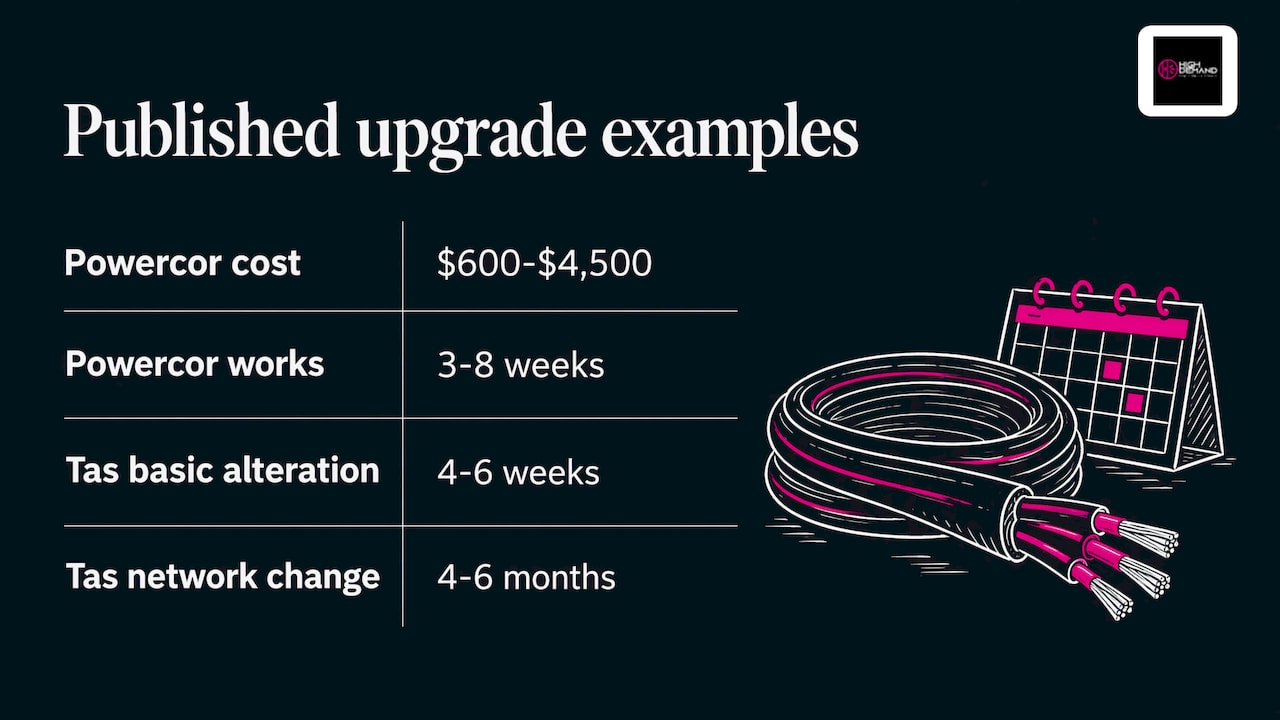
Published examples from other states show the range. Powercor in Victoria says prices typically run from $600 to $4,500 with most works taking 3 to 8 weeks. TasNetworks says basic alterations average 4 to 6 weeks for its part, while negotiated ones that need network changes average 4 to 6 months. These are not NSW figures, but they show why a job that needs network work takes far longer than a like-for-like swap.
In NSW, ask your ASP early whether the job is a simple service-line change or needs the distributor to do network work. That single answer sets most of your timeline.
Safety and compliance on the switchboard side
Standards for the installation itself keep moving. Under AS/NZS 3000:2018 Amendment 2, new Type AC safety switches are no longer permitted after 30 April 2023, and EV chargers without built-in DC fault detection need Type B protection, as this RCD guide summarises. A full switchboard replacement also brings RCD protection to all final circuits. Plan for that when you budget an upgrade alongside a new charger.
Urgent repairs, temporary power and strata
Storm damage or a leaning pole. Keep away, treat every wire as live and call 000 if there is immediate danger. Once it is safe, our 24/7 emergency service covers make-safe, repair and replacement, and the repaired connection can often be upgraded in the same visit.
Builders. A temporary builder’s supply needs its own planning. Ausgrid charges a Site Establishment Fee where a new NMI is created, and Western Australia’s Horizon Power requirements note temporary power on construction sites must follow AS/NZS 3012 and recommend early notice. Confirm timing with your ASP, along with whether neighbours or tenants will lose power.
Property managers. Confirm any defect notice is rectified, and for strata schemes get committee permission before applying. Western Power’s strata guidance in WA shows the principle: lot owners draw on a shared capacity allocation.
How we can help
We are a Sydney Level 2 ASP team with 24/7 emergency response, covering pole repair and replacement, new private pole installation, consumer mains, overhead-to-underground conversion, disconnect and reconnect work, temporary builders’ supply and metering. Tell us what you want to power and we will inspect and quote.
See our power pole installation services or contact us through High Demand Power Poles.
FAQ
Can I upgrade my own power connection in NSW?
No. Work connecting, disconnecting or changing supply between your property and the network must be done by an ASP under the Electricity Supply Act 1995. An electrician without the right accreditation level cannot do it.
Do I need three-phase for an EV charger?
Not always. Many homes can add a charger on single-phase if the connection has capacity, and Victorian guidance notes a larger single-phase connection is often cheaper than three-phase. A diversity assessment of your existing supply gives the answer for your site.
Who owns the upgraded connection?
For Ausgrid, the customer funds new or altered connection assets, and Ausgrid then takes ownership and maintains them. Private poles are a different case, so confirm ownership with your ASP.
How long does an upgrade take?
It depends on whether the network needs work. Examples from other states run from a few weeks for simple alterations to several months for negotiated ones. Ask for an estimate in your written quote.
Sources
- NSW Government: installing or altering electricity supply
- NSW ASP Scheme
- Power Up Your Home (Victorian Government)
- Ausgrid Premises Connection Requirements
- Powercor: change your existing power supply
- TasNetworks: alter an existing connection
- RCD safety switch requirements guide
- Horizon Power service and installation requirements
- Western Power: increase residential supply
Recommended
- Consumer Mains Upgrade on a Pole-Fed Home: Cost, Process and When You Need One (Sydney)
- Can My Private Power Pole Handle Three-Phase? Upgrade Guide for Sydney Pole-Fed Homes
- Overhead to Underground Power Conversion in Sydney: The End-to-End Process Explained
- Private Power Pole Replacement Sydney: Costs, Process & What to Expect
Need a Level 2 ASP for your private power pole? Call the High Demand Power Poles Sydney team for a free quote.
Call 0411 719 093Related reading
Ready to get your power pole sorted?
Fill out the form and our expert team will get back to you shortly. Whether it’s an emergency or a planned installation, we’re ready to help: fast, safe, and professional.